
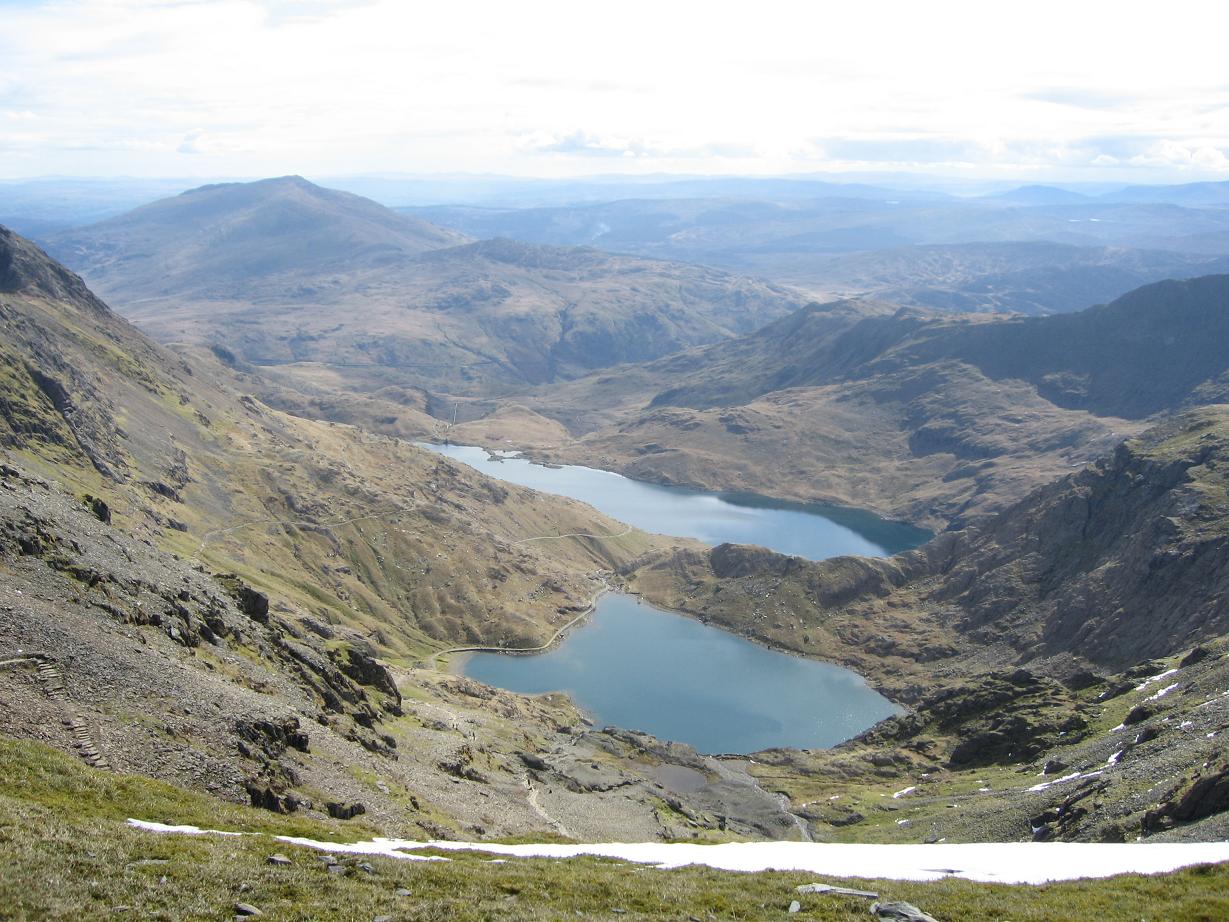
Glaslyn sits at 600 metres in a steep-walled cwm on the eastern face of Snowdon, its extraordinary copper-green water reflecting the dark cliffs above. Few mountain lakes anywhere are as dramatically situated — or as strangely coloured. The green hue comes from dissolved copper minerals washed from the old mine workings that surround its shore.
Quick Facts
- Altitude: 600 m
- Access: Miners' Track or Pyg Track from Pen-y-Pass
- Best for: Dramatic mountain photography, industrial heritage
- Nearest village: Llanberis (6 km) or Nant Peris (4 km)
The Lake
Glaslyn occupies a classic glacial cwm — a bowl carved by a hanging glacier during the last ice age. The surrounding cliffs rise steeply on three sides, and the summit of Yr Wyddfa is visible above the headwall. The lake is roughly oval, about 400 metres long, and sits just above the ruins of the Britannia Copper Mine, which operated from the 1820s until the early 20th century. The ruins on the shore — stone walls, collapsed machinery housings, and spoil heaps — give the lake a melancholy industrial atmosphere at odds with its natural beauty.
Below Glaslyn, connected by a short outflow stream, lies Llyn Llydaw — a larger, more accessible lake with a causeway built in 1853 to allow miners to reach the workings on the far shore. The causeway is still walkable and is crossed by the Miners' Track on its way to Glaslyn.
Getting There
The Miners' Track from Pen-y-Pass (SH 647 556) is the standard approach, rising gradually alongside Llyn Llydaw before climbing more steeply to Glaslyn. The walk to the lake takes about 1.5 hours one way. The Pyg Track offers a higher alternative that joins the Miners' Track at the lake shore. Both routes begin from the Pen-y-Pass car park, which must be booked in advance during summer months via the Snowdonia National Park website.
What You Will See
The copper-green colour of the water is the most immediately striking feature and photographs beautifully in morning light when the lake is calm and the cliffs above are lit. Peregrine falcons nest on the cliffs above the lake and are regularly seen hunting over the cwm. The mine ruins are of genuine industrial archaeological interest — information boards on the Miners' Track explain the history of copper extraction here. In winter, ice regularly forms at the lake margins and snow fills the cwm above, making this one of the most atmospheric winter walking destinations in Eryri.
Independently written — Snowdon.com