
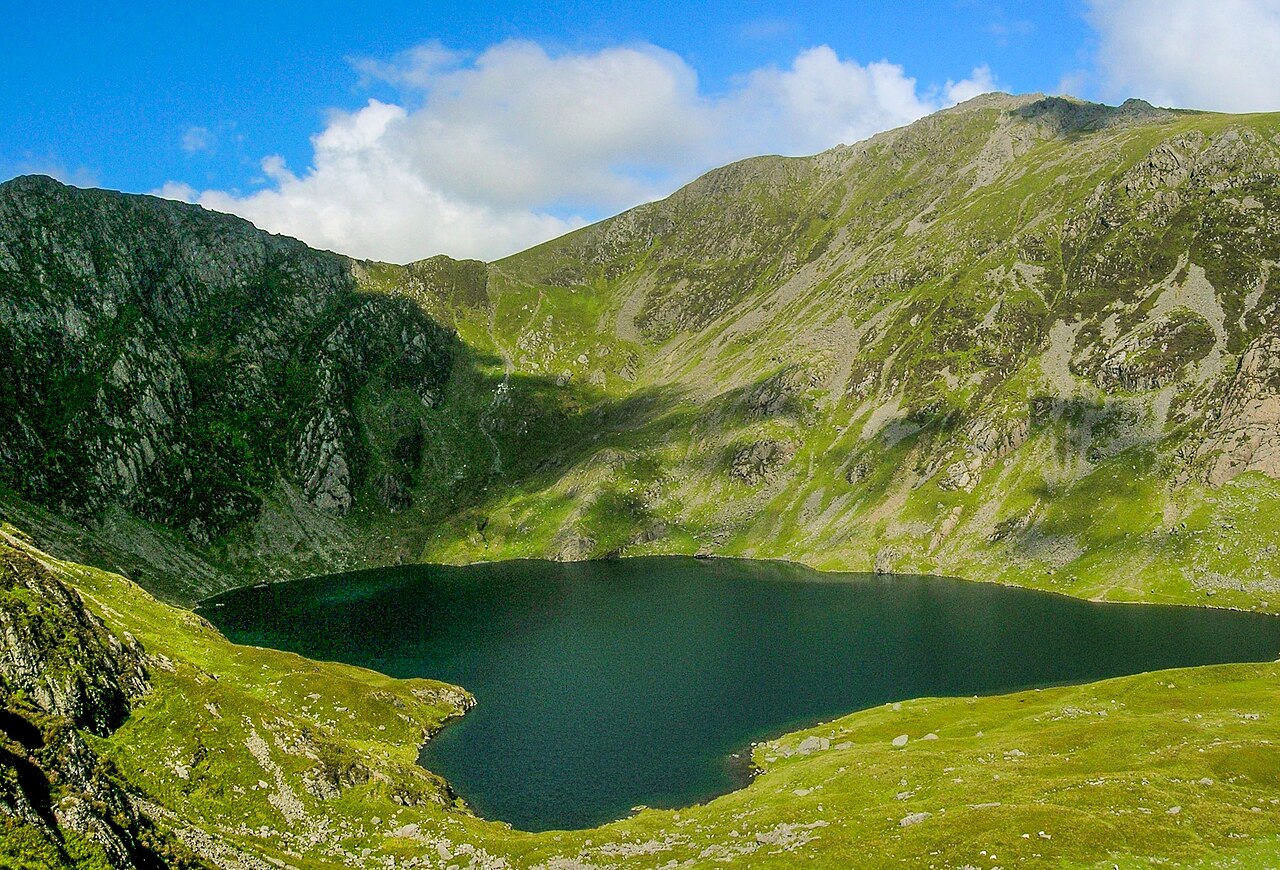
Cadair Idris rises abruptly from the flatlands south of Dolgellau, its long summit ridge and sheer northern cwms making it one of the most dramatic mountains in Wales. The name means "Chair of Idris" — a reference to a giant or bard of Welsh legend who supposedly sat here to compose poetry and observe the stars. The legend adds: sleep a night on the summit and you will wake either mad or a poet.
Quick Facts
- Height: Penygadair 893 m (2,930 ft)
- Grade: Strenuous walk; no scrambling required on main routes
- Start point: Minffordd (SH 732 115) or Ty Nant, Dolgellau
- Time: 4–6 hours return
- Don't miss: Llyn Cau — the most dramatic cwm lake in Wales
The Mountain
The summit ridge of Cadair Idris runs roughly east-west for several kilometres, with the highest point Penygadair near the centre. The southern flanks are relatively gentle, but the northern face drops precipitously into deep glacial cwms — hollows carved by ice during the last glaciation, each cradling a dark lake. Llyn Cau, enclosed within the eastern cwm on the Minffordd approach, is the largest corrie lake in Wales and one of the most beautiful mountain lakes anywhere in Britain.
The geology of Cadair Idris is largely Ordovician igneous rock — volcanic lavas and tuffs that were intruded, folded, and later sculpted by ice. The dark cliffs above Llyn Cau are impressive at any time of year, and in winter they hold snow long after lower ground has thawed. Cadair Idris marks the southern boundary of the Eryri National Park.
Routes to the Summit
Minffordd Path: The most dramatic and popular route. From the car park at Minffordd, the path climbs steeply through oak woodland before emerging at the shore of Llyn Cau. The onward route circles the cwm rim and climbs to the summit. The combination of woodland, cwm lake, and high ridge makes this the most varied and rewarding ascent. Allow 5 hours return.
Pony Path (from Ty Nant): The oldest and most gradual route, used for centuries to bring tourists to the summit on horseback. It approaches from the west via a long, sweeping ridge. Less dramatic than the Minffordd Path but easier underfoot and better in poor visibility. Allow 4–5 hours return.
Fox's Path: A steep and badly eroded gully descent on the northern face. Once popular as a descent route, it is now strongly discouraged — the path has collapsed in sections and the loose scree is dangerous. Use the Pony Path or Minffordd Path for both ascent and descent.
Practical Notes
Cadair Idris creates its own weather, with cloud and rain arriving quickly from the west. Conditions on the summit ridge can be fierce even when Dolgellau in the valley below is calm and sunny. Waterproofs and warm layers are essential year-round. The summit shelter (a stone howff) provides some protection but is cramped in busy conditions. The Minffordd car park is small and fills early on summer weekends — arrive by 9am or use the overflow area at the road junction. The mountain is also a designated Site of Special Scientific Interest for its geology and arctic-alpine plant communities.
Independently written — Snowdon.com