
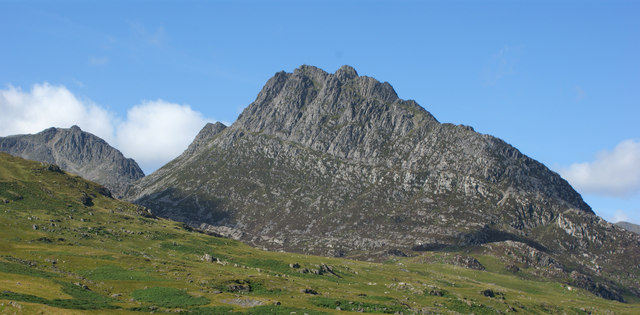
Tryfan stands at 915 metres above the Ogwen Valley and is widely considered one of the finest mountains in the British Isles. Unlike most Welsh peaks, it cannot be reached without using your hands — every route to the top involves at least some scrambling — which gives it a character entirely its own.
Quick Facts
- Height: 915 m (3,002 ft)
- Grade: Grade 1 scramble (North Ridge); moderate on south approaches
- Start point: A5 roadside layby, Ogwen Valley (SH 663 603)
- Time: 3–5 hours return
- Don't miss: Leaping between Adam and Eve on the summit
The Mountain
Tryfan rises directly from the A5 as a jagged ridge of dark gabbro rock — rough-textured, grippy, and utterly unlike the smoother rhyolite found elsewhere in Eryri. The mountain is part of the Glyderau group and sits at the eastern end of that massif, separated from Glyder Fach by the col of Bwlch Tryfan.
The rock is ancient and volcanic in origin, formed during the Ordovician period around 450 million years ago. The roughness of the gabbro is legendary among climbers — it bites into boot rubber like sandpaper and gives exceptional friction on steep terrain. Heather, bilberry and mountain grasses cling between the boulders on the lower flanks, giving way to bare rock near the top.
The summit is crowned by two standing boulders called Adam and Eve, each roughly two metres tall and separated by a gap of about a metre. The tradition of leaping from one to the other — earning the freedom of Tryfan — is as old as organised hillwalking in Wales. Both boulders wobble slightly when stood upon, which concentrates the mind wonderfully.
Routes to the Summit
North Ridge: The classic route and one of the finest Grade 1 scrambles in Britain. From the A5 layby, a well-worn path leads directly up the crest of the ridge. The scrambling is continuous but never desperate, with good holds throughout. Navigation is simple — stay on the crest. Allow 2.5 hours to the top.
Heather Terrace: A less technical alternative that traverses the eastern flank before ascending via gullies to the south top. Longer and scrappier than the North Ridge but avoids the most exposed sections. Useful in high wind or if confidence on exposed scrambling is limited.
South Ridge and Bwlch Tryfan: Approached from the Ogwen Valley path via Llyn Bochlwyd, this route joins the mountain from the south and combines naturally with a traverse onto Glyder Fach via Bristly Ridge — itself a superb Grade 1 scramble that completes a magnificent horseshoe.
Practical Notes
Scrambling boots with good ankle support are essential — trainers are dangerous on this mountain. A helmet is advisable if the mountain is busy, as loose rock can be dislodged by parties above. The North Ridge becomes a serious proposition in winter when ice and snow are present; crampons and an ice axe are then required and experience is assumed.
The A5 laybys fill early on summer weekends. Arrive before 8am or use the Ogwen Cottage car park (pay and display). The mountain dries quickly after rain due to its rocky nature, but damp gabbro is still grippy compared with other rock types. Mist can descend fast — a compass bearing from the summit to Bwlch Tryfan is useful to have prepared.
Independently written — Snowdon.com