
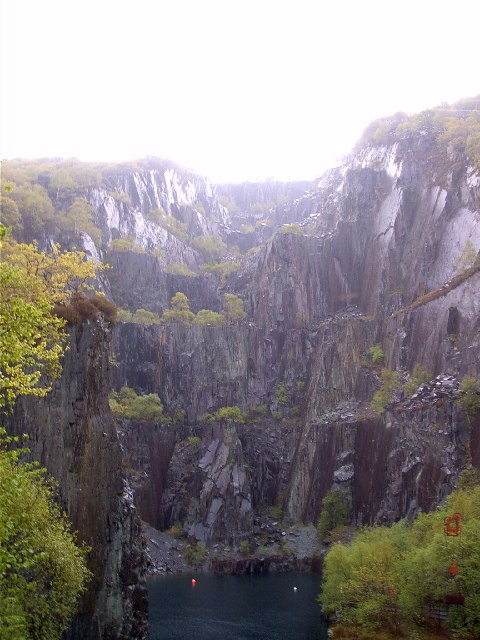
The slate landscape of north Wales is one of the most remarkable industrial landscapes in the world — and in 2021, it became a UNESCO World Heritage Site. The great quarries above Bethesda, Llanberis, and Blaenau Ffestiniog, the terraced workers' villages, the narrow-gauge railways that carried slate to the sea, and the communities that formed around the industry together constitute a landscape inseparable from the mountains of Eryri.
The Geology
The slate of north Wales is Cambrian and Ordovician in age — between 488 and 540 million years old. It was formed from fine-grained marine muds, then subjected to heat and pressure during the Caledonian mountain-building episode. The resulting metamorphic rock splits cleanly along parallel planes of weakness (the cleavage) at angles that often differ from the original bedding — a characteristic that makes north Wales slate uniquely suitable for roofing. At the height of the Victorian slate industry, north Wales supplied around 90% of the world's roofing slate.
Penrhyn Quarry — The World's Largest
At its Victorian peak in the 1890s, the Penrhyn Quarry above Bethesda employed around 3,000 men and produced over 130,000 tonnes of slate per year. The quarry extends for nearly 2km in length and over 400m in depth. The terraced galleries — up to 60 benches cut into the rock face — are visible from the A5 through Bethesda and from the ridge of Carnedd Dafydd above. The quarry was owned by the Penrhyn family, who used the profits to build the neo-Norman Penrhyn Castle (now National Trust) above Bangor.
The Great Penrhyn Strike, 1900-1903
The Penrhyn Quarry strike of 1900-1903 was the longest industrial dispute in British history — 2,800 men locked out for three years over the right to union representation and fair wages. Lord Penrhyn refused all negotiations and imported labour from outside the area. The effects on the community of Bethesda were catastrophic; the community was divided between those who stayed out and "bradwyr" (traitors) who returned to work. The dispute ended without a formal settlement — the men drifted back, many permanently blacklisted. The social memory of the strike persisted for generations. The story is told at the National Slate Museum in Llanberis.
Dinorwic and the National Slate Museum
The Dinorwic Quarry above Llanberis was the second-largest in north Wales — over 3,000 workers at its peak. The quarry closed in 1969. The Victorian workshops are now the National Slate Museum (free admission), preserving the workshops in working condition. The 15.4m diameter water-wheel (the largest surviving in mainland Britain) is operational; demonstrations of slate splitting show the extraordinary skill the trade required.
Llechwedd and Blaenau Ffestiniog
The Blaenau Ffestiniog slate industry operated underground mines rather than open quarries. The Llechwedd Slate Caverns give access to the underground workings on guided tours; the Victorian-era tramways and cutting galleries, preserved since the mine's commercial decline, convey the scale of the underground operation. The town of Blaenau Ffestiniog is built entirely from the products of its industry and surrounded by enormous tips of waste slate.
UNESCO World Heritage: The Slate Landscape of Northwest Wales
The UNESCO inscription in 2021 covers not just the quarries but the whole cultural landscape — the quarrymen's villages, the narrow-gauge railways (Ffestiniog Railway, Welsh Highland Railway, and the Padarn Railway trackbed), the quays at Porthmadog and Port Penrhyn, and the cultural heritage including the Welsh language, choral music, and nonconformist chapel architecture that the industry's communities produced. The inscription was a long-overdue recognition that this industrial landscape is as significant as the natural landscape it coexists with.
Independently written — Snowdon.com