
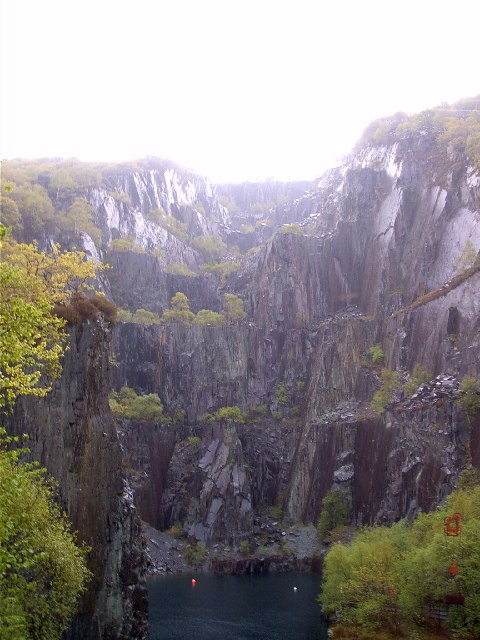
Rain in Eryri is not a failure. It's weather — and Eryri in the rain is still one of the most dramatic landscapes in Britain. The waterfalls are fuller, the slate darkens to near-black, the rivers run fast and brown, and the valleys fill with mist in ways that feel genuinely elemental. The key is having different plans for wet days, rather than staring at the mountains through a hotel window.
Ffestiniog and Welsh Highland Railways
The Ffestiniog Railway is one of the great narrow-gauge railways in the world — and one of the few things that is actually better in light rain than in blazing sun. The narrow-gauge line (1ft 11½in gauge) runs 22km from Porthmadog harbour through oakwood, mountain, and moorland to the slate town of Blaenau Ffestiniog, climbing 213m along the way. Opened in 1836 to carry slate to the coast, converted to passenger use in 1865, closed in 1946, and restored by volunteers from 1955 onward, it has a claim to being the most loved heritage railway in Wales.
The Welsh Highland Railway runs 40km from Caernarfon through Beddgelert and the Aberglaslyn Pass to Porthmadog — a spectacular route through the heart of southern Eryri. The two railways connect at Porthmadog, allowing an 80km circular journey by rail through the national park.
National Slate Museum, Llanberis
Free admission. Housed in the Victorian workshops of the Dinorwic Quarry, the National Slate Museum is one of the best industrial museums in Wales — genuinely interesting rather than merely worthy. The original workshops are intact, the massive water-wheel (the largest surviving in mainland Britain, at 15.4m diameter) is operational, and the demonstrations of slate splitting show a craft that shaped north Wales for two centuries. The quarrymen's cottages, furnished to different decades of the twentieth century, are illuminating.
Electric Mountain, Llanberis
Beneath the Elidir Fawr mountain, the First Hydro Company operates one of Britain's largest pumped-storage power stations — 1,800 megawatts of generating capacity housed in caverns carved from the rock. Free tours run regularly and take visitors underground on a bus through the access tunnel. The scale is staggering: the main machine hall is the size of a cathedral. The station can go from zero to full power in 12 seconds, making it essential for balancing the national grid during sudden demand spikes.
Portmeirion
The Italianate fantasy village built by Clough Williams-Ellis between 1925 and 1975 on a private peninsula above the Dwyryd Estuary is one of the most extraordinary places in Wales — and it's extraordinary regardless of the weather. Williams-Ellis rescued architectural fragments from demolished buildings across Britain and incorporated them into his Mediterranean vision, creating a village that shouldn't work but emphatically does. Best known internationally as the filming location for the 1960s television series The Prisoner. The woodland garden and estuary views are superb.
Swallow Falls, Betws-y-Coed
Small admission charge, 3km west of Betws-y-Coed on the A5. The Afon Llugwy drops over a series of falls into a rocky gorge — the most visited waterfall in Wales. It is, objectively, better in heavy rain when the river is full. The falls are visible from viewing platforms on both banks. The woodland setting, with sessile oaks and mossy boulders, is beautiful in any conditions.
Harlech Castle
A UNESCO World Heritage Site and one of the great medieval fortresses of Europe. Edward I's concentric castle, built 1282–1289 on a rocky promontory above the coastal plain, is exceptional in its completeness — the walls and towers stand largely to their original height, and the great gatehouse is among the finest examples of military architecture in Britain. In rain and low cloud, the atmosphere is extraordinary. The views over the Tremadog Bay and back to the mountains on a clearing day are not to be missed.
Llechwedd Slate Caverns, Blaenau Ffestiniog
Underground tours through the Victorian slate mine, now operating as a tourist attraction. The Deep Mine tour descends on the steepest cable railway in Britain to explore the underground workings. The Victorian village built within the caverns shows the scale of the industrial operation. Blaenau Ffestiniog itself — a town built entirely from slate — is worth exploring: the grey terraces and the enormous spoil heaps above the town have a severe, austere beauty.
Cafes and Pubs
A non-ironic recommendation. Eryri has an excellent cafe culture for a remote mountain area: Pete's Eats in Llanberis (a walkers' institution, enormous portions since 1980), the Pen-y-Gwryd Hotel at the foot of Llanberis Pass (unchanged since the 1953 Everest team's training base), Caffi Gwynant in Nantgwynant, and the Bryn Tyrch in Capel Curig are all worth making for on a wet afternoon. A bowl of cawl (the Welsh lamb and leek broth) with bread in a warm pub while the rain hammers the windows is, in its way, a quintessential Eryri experience.
Independently written — Snowdon.com