
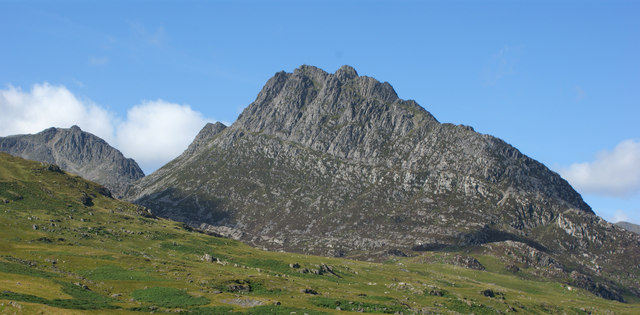
There is something different about Eryri. Visitors frequently remark on it without being able to quite say what it is — a quality more than its mountains or its weather, more than its beauty or its wildness. It has to do with the Welsh language, with the history of this territory, with the particular way the landscape has been shaped and described and inhabited for over a thousand years.
The Language
Walk into a cafe in Capel Curig or a pub in Llanberis and the conversation around you is likely to be in Welsh. Not as a tourist performance or cultural display — as the ordinary medium of daily life. Around 60% of residents in Eryri speak Welsh as their first language, compared to 29% across Wales as a whole. In some communities, the proportion is over 80%.
This matters to how the landscape feels because the language is woven into every place name you see — and Welsh place names are almost always descriptive. Bwlch y Moch means "pass of the pigs." Crib Goch means "red ridge." Pen-y-Pass means "head of the pass." You are moving through a landscape that has been precisely, accurately named in a language that has never gone away. This gives Eryri a specificity that landscapes named in English — where the original meanings are often lost — rarely achieve.
The Geology
The rocks of Eryri are old in ways that are difficult to comprehend. The summit of Yr Wyddfa is Ordovician mudstone, formed 444 million years ago on the floor of a vanished ocean. The volcanic rocks of the Glyderau were formed in an ancient volcanic arc 10 million years before that. The landscape's current form is more recent — the work of the last ice age. The cwms, aretes, and ribbon lakes were carved by glaciers that retreated only 10,000 years ago. The landscape feels new and raw — the glacial features are still sharp, not yet smoothed by millions of years of subsequent erosion.
The History of Resistance
Edward I built his ring of fortresses around Eryri — Caernarfon, Conwy, Harlech, Beaumaris — not because he had conquered the Welsh of Gwynedd but because they were difficult to conquer. The castles are, in a sense, an admission of the difficulty. The mountains of Eryri had protected the princes of Gwynedd from every previous assault; Edward's response was to encircle the mountains rather than penetrate them. This history is present in the landscape in a way that more thoroughly conquered territories sometimes lack. The Welsh castles at Dolbadarn and Dolwyddelan — built by Welsh princes — are a reminder that this was not empty mountain country awaiting colonisation. It was a polity, with its own architecture, its own law, and its own language that proved unkillable.
An Older Britain
What visitors often respond to in Eryri — without naming it directly — is the sense of encountering something continuous. The landscape has been inhabited and described and argued over and loved in an unbroken tradition for over a thousand years. The mythology connects specific places to stories that are genuinely ancient — not reconstructed or invented for tourist purposes, but organic accumulations of meaning attached to this rock, this lake, this pass.
Much of Britain has had its continuous traditions interrupted by industrialisation, urbanisation, or cultural assimilation. In Eryri, the interruption has been less complete — the language has continued, the landscape has remained largely intact, and the sense of a place with a deep, unbroken past is more available than in most of Britain.
The Eagles
The white-tailed eagle, extinct as a breeding bird in Wales for centuries, has been reintroduced and is now regularly sighted over the Dyfi Estuary and increasingly over the Eryri mountains. The red kite, reduced to a tiny remnant population in central Wales in the 1970s, now soars over the Conwy valley and the Mawddach. The peregrine falcon nests on the crags above Cwm Idwal. The landscape is slowly recovering its wildness — not as a managed heritage artefact but as a living system. Eryri is one of the few places in England and Wales where something like ecological restoration is genuinely underway.
Independently written — Snowdon.com